
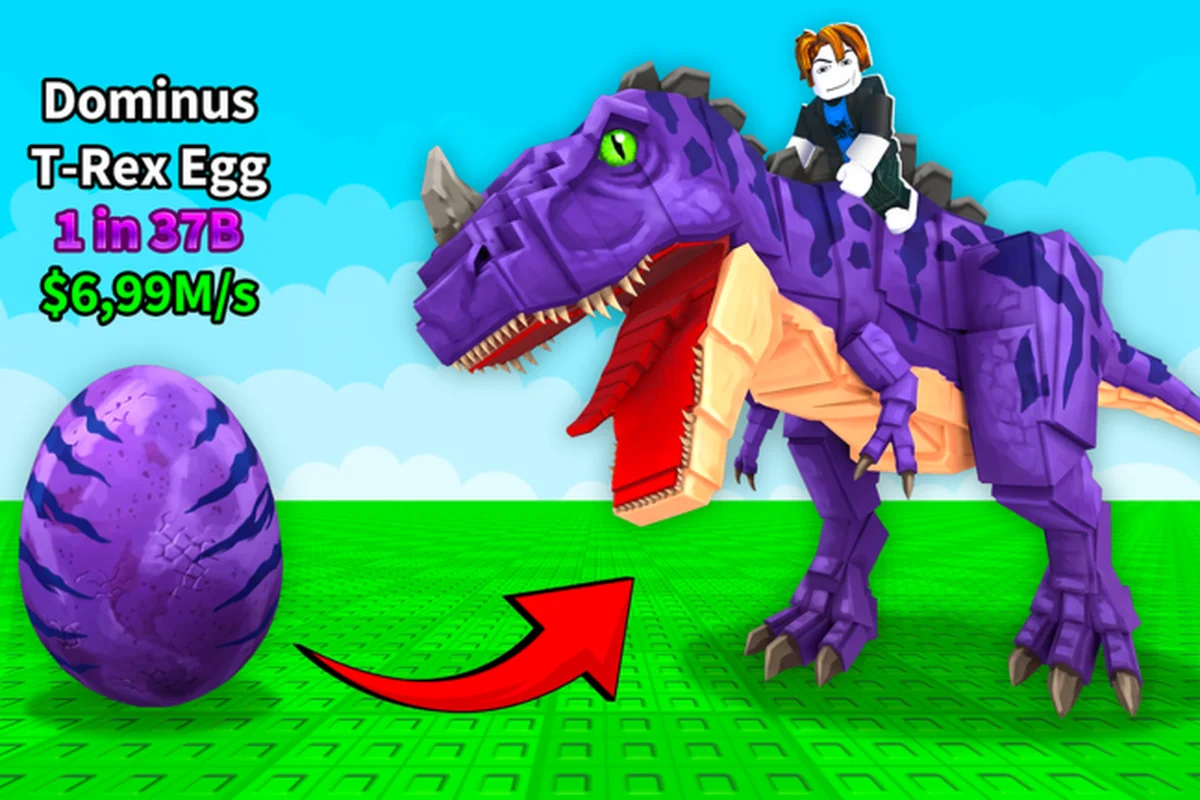
Ride a Dino drops you into a six-player server where the only thing standing between you and a better mount is a hidden Dino Egg. Knowing what to chase on day one separates a player who is still jogging across the map from one who is already scouting the next hatch. This guide breaks down what to focus on first in Ride a Dino, how to pick the best beginner dino for your play style, and which early habits quietly cost you hours of progress. If you want a deeper walkthrough of the early-game priorities we outline here, the Ride A Dino Beginner Guide expands on the hatch-and-ride fundamentals every new rider should lock in before pushing toward the mid-game.
The Core Mechanic Loop and Why Day One Decisions Matter
Ride a Dino runs on a tight, repeating loop that the official Ride a Dino page on Roblox describes in five moves: roam the map to uncover concealed dino eggs, hatch dinos that come out quicker and rarer than the last, ride a swifter mount to open eggs tucked further out, mutate your dinosaurs to push speed even further, and collect rare dinos to round out your collection. Every cycle hands you a slightly faster mount, which in turn unlocks the next layer of the map. The first thirty minutes decide whether you enter that loop or stall on the outside looking in.
The loop rewards one thing above all: movement speed. A faster dino does not just feel nicer, it physically opens up new egg locations that a slower mount cannot reach in time. Beginners who latch onto this idea on day one tend to compound their gains, while beginners who ignore it spend their first hour revisiting the same starter zone over and over.
What the Developer Leaves Unconfirmed
Ride a Dino launched on 2026-09-18 and is still being updated (most recent recorded update 2026-10-12). As of 2026-10-18, the developer has not published a species list, has not named any rarity tier, and has not announced any specific mutation by name. The only paid upgrade the developer confirms is the Infinite Radar game pass, which is described officially as a radar you can use forever that always finds the nearest egg. Any tier list, egg name, or speed number you see on a third-party site almost certainly comes from a different, similarly-named game on Roblox. Treat those lists as fan speculation, not facts.
The Day-One Decision Stack
| Priority | Action | Why It Comes First |
|---|---|---|
| 1 | Locate your first hidden egg | Starts the entire mechanic loop |
| 2 | Hatch and equip the resulting dino | Mounting is faster than running on foot |
| 3 | Explore outward from the spawn zone | New zones hide higher-rarity eggs |
| 4 | Save before risky routes | The game has no respawn-cost system, but lost progress still costs time |
| 5 | Re-evaluate after every two hatches | Compounding speed is the only true progression |
After the fifth egg, the compounding-speed curve becomes self-evident: the first common dino might cut traversal time by 20%, but by the time you swap in a rare-tier dino from the second ring, your sprint and stamina regen from the mount will roughly double compared to the starter, turning previously out-of-reach egg clusters into routine detours on the next pass.
Picking the Best Beginner Dino Without a Published Tier List
The phrase "ride a dino best beginner dino" only means something once you accept that the developer has not ranked dinosaurs by name. Instead, you judge candidates on three attributes the official description does confirm: speed, rarity, and mutation potential. A dino that scores well across all three is a strong first pick. A dino that only looks flashy but does not hatch a faster mount is a trap.
The Three-Attribute Method
The method itself is simple, but the discipline is what saves you time: hold every new dino you hatch against the same three questions before you spend a single coin feeding, leveling, or slotting a mutation into it, because sunk cost on the wrong hatch is the single biggest early-game mistake new riders make in Ride a Dino.
-
Is it faster than my current mount? If not, the only reason to keep it is collection value, and collection value is a long-game resource, not a day-one one.
-
Is its rarity at or above what I already own? Rarity in Ride a Dino is described as a quality that scales with effort, and higher rarity hatches tend to push speed higher as well.
-
Does it have at least one mutation slot worth investing in? Mutations compound, so a dino you plan to mutate is worth far more than a slightly rarer dino that cannot be mutated.
A new dino that passes all three checks — speed, rarity, and a viable mutation slot — is a keeper you can safely invest coins, XP, and mutation rerolls into without second-guessing the spend. A dino that only passes one or two is a placeholder: bench it in your second slot, ride it just enough to keep progressing, and swap it the moment the next egg hatches something that clears the full three-attribute screen, because every coin you sink into a partial-pass placeholder is a coin your eventual keeper will never see again.
Grading a Dino Without a Roster
| Tier | What It Means in Practice | Day-One Role |
|---|---|---|
| S-tier mount | Top speed, top rarity, mutation slot open or already strong | Chase immediately, mutate on sight |
| A-tier mount | Solid speed, decent rarity, mutation slot usable | Keep until a clear upgrade hatches |
| B-tier mount | Faster than starter, but rarity is mid | Use to scout, replace within an hour |
| Starter-tier mount | The dino you spawn with or hatch on your very first egg | Replace as soon as possible |
You do not need to know species names to apply this framework. As of 2026-10-18, the developer has not released a species list, so the names attached to each tier change with every update. What stays constant is the relationship: speed unlocks the next egg, rarity gates how strong a hatch can be, and mutation multiplies everything you already have.
Common Beginner Misreads
A lot of new players chase the dino that looks the most unusual in the hatch animation, then wonder why their second-hour progress feels flat. Flashy does not equal fast. The dino that looks the most exciting on screen can easily sit in B-tier when judged by the three attributes above. The most reliable way to avoid that mistake is to treat every hatch as a side-grade check, not a celebration. If the new dino does not clearly beat your current mount on at least one attribute, bench it and keep riding.
Early Game Mistakes That Quietly Cost You Hours
Most early game mistakes in Ride a Dino are not catastrophic. They are slow leaks. A new player who keeps making them does not fail outright, they just spend two hours doing what a focused player does in forty minutes. The good news is that every leak has a simple fix once you can name it.
The Five Most Common Early Mistakes
| Mistake | What It Costs | The Fix |
|---|---|---|
| Ignoring mutation entirely | Leaves the strongest speed multiplier on the table | Mutate every keeper dino before chasing the next egg |
| Riding back to base between every hatch | Wastes the only resource you cannot buy, which is in-session time | Stay mounted and explore outward from each new egg |
| Saving the Infinite Radar pass purchase for "later" | Keeps the slowest part of the loop, which is finding eggs, slow | The pass is the only paid upgrade the dev has documented, so it pays for itself in any long session |
| Treating the starter dino as a long-term mount | Locks you into the lowest speed bracket of the game | Replace the starter as soon as any new hatch beats it on speed |
| Reading third-party tier lists as gospel | Pushes you to chase species names that do not exist in this build | Use the three-attribute method instead of any named list |
Why "How to Not Waste Time" Is the Right Question to Ask
The phrase "ride a dino how to not waste time" is not just a search query, it is the actual job of your first session. Every other system in the game feeds back into the same loop, so every minute you spend in slow mode is a minute you are not finding the egg that would have made you faster. The fastest path forward in Ride a Dino is almost always the path that values time-in-mount over time-in-base.
A practical example: a player who pops back to base after every hatch to admire their new dino will spend roughly a third of their session on foot. A player who stays mounted and hunts the next egg on the way back to base stays in the speed bracket that lets them reach harder eggs. The second player is not better at the game, they have just stopped giving the loop a reason to slow down.
How the Loop Reacts to Neglect
| Habit | Day-One Effect | Day-Three Effect |
|---|---|---|
| Skipping mutation | No immediate loss | Speed curve flattens, harder eggs stay out of reach |
| Rushing into new zones without a faster mount | Wasted exploration, no eggs found | Frustration builds, session ends early |
| Treating collection as the main goal | Time spent admiring instead of hatching | Collection grows slowly, but speed does not |
| Buying the Infinite Radar pass late | Same slow start as every other player | Catches up only after several wasted sessions |
The first three habits hurt you by the second day, not the first. That delay is what makes them so easy to ignore. The fix is the same in every case: re-read the official mechanic loop and pick the slowest step. Whatever step is slowest is the one your habits are leaking time into.
Building a First-Hour Plan That Actually Works
A first-hour plan in Ride a Dino is less about grinding and more about running the loop tightly enough that you finish the hour with a noticeably better mount. The plan below assumes a clean save, no game pass, and a six-player server, which is the documented server cap on the official Ride a Dino Roblox page.
The 60-Minute Checklist
| Minute | Goal | Output |
|---|---|---|
| 0-10 | Find your first hidden egg and hatch it | A mount that is faster than the spawn run speed |
| 10-25 | Use the new mount to scout the area around spawn | A mental map of which zones you can already reach |
| 25-40 | Hunt a second egg, ideally one the starter could not reach | A side-grade or upgrade mount |
| 40-55 | Compare both mounts, mutate the keeper, bench the loser | A mutated main dino with a known backup |
| 55-60 | Re-evaluate: is the next egg reachable in this session? | A clear "yes, stay in" or "no, hop to a fresh server" call |
The plan never tells you to collect every dino you hatch, and it never tells you to memorize the map — both of those are long-game goals you can park for week two. The first hour is purely about compounding speed, because the faster your starter, the more ground you can cover between 10-25, which directly raises the odds of finding a second egg at the 25-40 mark. Skip that compounding, and you will still be running on foot when the 55-60 re-evaluation window opens, locking you out of the "yes, stay in" call and forcing a wasted server hop. Treat the table above as a dependency chain, not a checklist: each row's output is the prerequisite for the next row's input, and mutating at 40-55 only pays off if steps 0-25 were actually completed at speed.
When to Use the Infinite Radar Game Pass
The Infinite Radar game pass is the only paid upgrade the developer has documented, and its official description is a radar that always finds the nearest egg. That single sentence tells you exactly when the pass pays off: any time you would otherwise spend wandering looking for the next hatch. For a casual player who logs in once a week, the pass is a luxury. For a player who wants to run the loop efficiently across several sessions, the pass removes the one step the loop cannot speed up on its own.
If you do buy the pass, slot it in around minute 15 of the first session, not minute 0. The first 15 minutes are about learning what an egg looks like in the wild, which the radar would otherwise hide from you. After that, the radar is pure time savings.
A Note on Codes and Off-Site Lists
A lot of search results for Ride a Dino will promise a redeem-code list or a hidden species tier. As of 2026-10-18, the developer has published zero redeem codes, and the developer has not released a species list at all. Anything you find under those headings is either fan-made, outdated, or borrowed from a different game on Roblox that shares the same name. Skip those pages. The official page, the Dino Riders! developer group on Roblox, and player-run Discord screenshots are the only sources worth trusting until the developer publishes more.
When to Switch Gears: Mid-Session Tells
Knowing what to focus on first in Ride a Dino is partly about knowing when to stop focusing on the same thing. The loop has a natural rhythm, and the rhythm breaks at predictable points. The tells below are based on the documented mechanic loop and on community reports from the first month of play.
Tells That You Are Ready to Push Deeper
| Tell | What It Means |
|---|---|
| Two hatches in a row improved your speed | The loop is compounding, keep going |
| Your current mount can reach a zone you could not reach an hour ago | You have unlocked the next layer of the map |
| Mutation slots are filling up on your main dino | Speed is about to spike, time to commit |
| The server still has open slots | A fresh player is unlikely to crowd you out of nearby eggs |
Tells That You Are Stuck
| Tell | What It Means |
|---|---|
| Three hatches in a row did not improve your speed | You are picking up collection-only dinos, swap your next target |
| You are spending more time running than riding | Either your mount is too slow or you keep dismounting for no reason |
| You keep circling the same two zones | The map layer you are on is exhausted, you need a faster mount to reach the next one |
| You cannot find any egg for ten minutes straight | The radar pass, or a server hop, is now worth the cost |
A useful rule of thumb: if you cannot name the slowest step in your current hatch-to-ride loop, you are bleeding seconds on something fixable. Common culprits include backtracking across ground you already cleared, circling the same two zones when pushing to the next ring would reveal new eggs, or dismounting mid-route to check a radar ping that was already cold. Name the bottleneck, patch it, and the loop speeds back up.
Frequently Asked Questions
What should I focus on first in Ride a Dino?
Your first focus should be the mechanic loop itself, which is find an egg, hatch it, ride the result, then chase a harder egg. Speed is the only stat that unlocks the next layer of the map, so every decision in your first hour should feed back into a faster mount. Treat the starter dino as a placeholder and replace it the moment a new hatch is faster.
How do I pick the best beginner dino if the game has no published tier list?
Judge every hatch against three attributes: speed, rarity, and mutation potential. A dino that beats your current mount on at least one of those, and matches on the other two, is worth keeping. A dino that only looks rare but does not move faster is a collection piece, not a day-one mount. This method works regardless of which species the developer names later, because the three attributes are the only ones the official description confirms.
What are the most common early game mistakes in Ride a Dino?
The most common early game mistakes are ignoring mutation, riding back to base after every hatch, treating the starter dino as a long-term mount, reading third-party species lists as facts, and saving the Infinite Radar pass purchase for "later." Each of those habits is a slow leak rather than a hard fail, which is why they tend to stick around for the first few sessions. The fix in every case is to re-read the official loop and pick the slowest step, then unblock it.
Is the Infinite Radar game pass worth it for a beginner?
For a brand-new player, the pass is worth it after you have spent at least one session finding eggs on your own, so you understand what the radar is replacing. For a player who plans to log in several times a week, the pass pays for itself quickly because the only step the loop cannot speed up on its own is the search for the next egg. For a very casual player, the pass is a luxury and not a requirement.
Does Ride a Dino have redeem codes or a hidden species tier?
As of 2026-10-18, the developer has not published a redeem-code system for Ride a Dino, and the developer has not named any species, rarity tier, or mutation in the official channels. Any code list or named tier list you find elsewhere almost certainly belongs to a different, similarly-named game on Roblox. Stick to the official Ride a Dino page and the Dino Riders! group for verified information.