
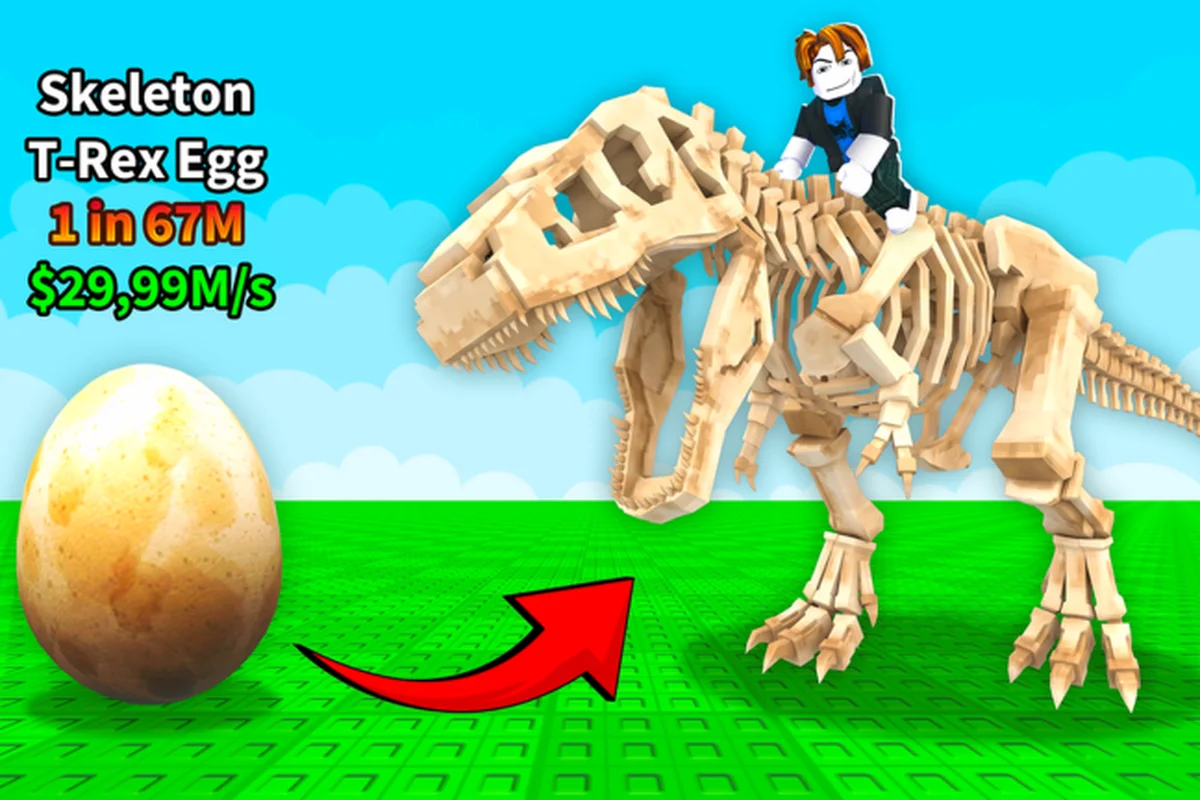
Ride a Dino throws you into a Roblox world built around a tight, repeatable loop, and most of the players grinding the map daily have learned that the difference between stalling at the spawn and reaching the rare eggs comes down to a handful of habits rather than any single trick. This collection of Ride a Dino useful tips pulls the highest-impact lessons into one place, so whether you are still on your first dinosaur or already eyeing the harder-to-find eggs on the far side of the map, you can level faster and waste fewer minutes on dead-end routes.
The game itself is short on official numbers — the developer has not published a species list, rarity tier names, mutation names, or any numeric speed, drop, or hatch values, so every concrete recommendation below is framed around the official mechanic loop and the patterns that the player base has worked out in the roughly thirty days since the game launched on 2026-09-18. Treat the numbers you see here as decision frameworks, not promises, and re-check after every patch.
Things to Know Before You Spawn In
Before you even touch your first egg, a few practical realities shape the rest of your session. Ride a Dino is a Roblox-only experience — there is no Steam, console, or mobile standalone build, so any guide that talks about cross-progression or a separate launcher is describing a different game. According to the Ride a Dino official Roblox page, the title was made by the developer group Dino Riders! and listed as a Simulation / Tycoon with a 6-player server cap, support for desktop, console, mobile, and tablet, and exactly one documented game pass called Infinite Radar.
The map is small enough that you can cross it on foot in roughly a minute with a starter mount, but most of the high-value eggs sit in spots that take a faster dinosaur to reach in a reasonable time. That is the entire premise of the loop: speed unlocks access, access feeds your roster, and your roster compounds. Skipping that chain and trying to brute-force the far side of the map with a slow starter is the single most common reason new players feel the game is "not for them."
| Pre-Spawn Reality | What It Means for You | Action Before First Egg |
|---|---|---|
| Roblox-only, no cross-save | Your progress lives on one account | Use a stable account; avoid guest mode |
| 6-player server cap | Saturated servers slow egg rotation | Hop to a quieter server if rotation stalls |
| One game pass (Infinite Radar) | Paid radar is the only documented edge | Decide your budget before you start |
| 30-day-old live-service game | Patches change spawns and balance weekly | Re-read patch notes before long sessions |
| No published species/rarity/mutation names | Lists from other "Ride a Dino" games do not apply | Ignore third-party tier lists until you verify the source |
One more thing worth knowing before you commit a long session: the experience has roughly 2.49 thousand players online at the time of writing and around 27.95 thousand favorites against 2.57 million total visits, with a like-to-dislike ratio of 87.7%. Those numbers tell you the game is active enough to keep server populations healthy, but not so crowded that you will be boxed out of every spawn point the way a flagship simulator can be. The visit-to-favorite ratio also suggests a strong retention curve, which is a fair answer to the common "Ride a Dino is it worth playing" question — if the population keeps choosing to come back after their first session, the loop is doing its job.
A Routine That Matches the Mechanic
Every progression decision in Ride a Dino eventually traces back to one cycle: find a hidden egg, hatch it, ride the dinosaur it becomes, mutate to push speed further, and use that speed to reach rarer eggs that feed the next round of the cycle. The official page lays it out almost word for word, and the Dino Riders! developer group confirms the same flow on its community page. Once you can see that chain in your head, almost every "useful tip" in the rest of this guide is really a way to compress one of those five steps.
How to Progress Without Wasting a Slot
Slots — the number of dinosaurs you can keep, ride, or carry at once — are the real currency of the early game, and most new players burn them on duplicates or low-rarity hatches before they understand the cost. A practical Ride a Dino leveling guide starts with one rule: treat every slot as if it is the only one you have, because for the first hour it almost is.
| Phase | Goal | Slot Discipline | Risk if You Ignore It |
|---|---|---|---|
| First 10 minutes | Reach the first cluster of eggs | Keep only the two fastest hatches | Inventory stalls before you reach a mount |
| 10–30 minutes | Unlock the second map region | Replace anything that does not move you faster | You stop reaching new spawns on foot |
| 30–60 minutes | First mutation attempt | Reroll only on a dino that has already proven its speed | You waste a mutation on a mount you will replace |
| 1–3 hours | Push toward rare eggs | Cut duplicates as soon as the rarity is matched | You carry three of the same mid-tier dino |
| 3+ hours | Build a showcase | Promote only hatched dinos you actually ride | The collection tab fills with benchwarmers |
Notice that the table never names a single species or rarity tier — that is intentional. As of 2026-10-18 the game has not published those names, and the player base has settled into a method-based ranking that compares hatches on speed × rarity × mutation payoff rather than on which dinosaur is "the best one." If you see a third-party tier list that confidently names a #1 dino, double-check whether the author is even writing about the same placeId (131652231424227) before you trust the order.
Reading Speed Without Official Numbers
Because no numeric speed values are published, "reading speed" comes down to feel and a few indirect signals. The clearest signal is whether a freshly hatched dino is visibly outpacing the one you rode to the spawn point — if yes, it is worth keeping on trial; if no, you are about to bench it within a session. The second signal is the spawn distribution itself: eggs that consistently sit behind long sightlines, high ledges, or out-of-bounds water tend to be the ones that the slow-starters never reach, which is why fast mounts cluster there.
A practical Ride a Dino efficiency guide uses three checkpoints rather than chasing a posted top speed, because the experience curve, biome pacing, and hatch reroll economy all reward benchmarks you can feel in a single session. The idea is to evaluate each candidate mount against the Time-to-cluster, Outpace-the-spawn, and Mutation sensitivity tests below, then bench or keep based on the combined verdict instead of a single gut call. Used together, these three gates act as a lightweight filtering pipeline for your trial roster, so you only feed resources — kibble, imprint cuddles, mutation rerolls — into dinos that have already cleared the practical speed bar for your current progression stage.
-
Time-to-cluster test: from spawn, how many seconds does it take to reach the next obvious egg cluster? Anything above a comfortable jog threshold on foot means the cluster is gated behind speed.
-
Outpace-the-spawn test: when you swap to a new hatch, does it visibly outrun the previous mount on a straight run? If the difference is hard to see, you are at the natural ceiling for that hatch.
-
Mutation sensitivity test: when you reroll, does the speed change feel meaningful or marginal? Marginal mutation results on a dino you already feel slow are usually a sign to swap rather than reroll again.
Efficiency Choices That Compound Over a Session
The word "efficiency" in a Ride a Dino efficiency guide means squeezing more meaningful actions out of the same wall-clock time, and three choices do most of the heavy lifting: server choice, route shape, and mutation timing. None of them cost Robux, and all of them stack.
Server Choice and the Respawn Question
Because the experience caps servers at 6 players, egg rotation in a busy server is faster, but so is competition for the spawns you can actually see. A quiet server gives you longer windows on each egg, but eggs respawn on a timer that nobody has fully reverse-engineered yet. The community rule of thumb is to hop servers when you have spent more than a couple of minutes without finding anything in a region you know holds eggs, rather than waiting in place for a respawn that may or may not have already happened.
| Server State | When It Works Best | When to Leave |
|---|---|---|
| Empty (1–2 players) | Early-game learning routes | When you start seeing the same egg twice in a row |
| Medium (3–4 players) | Most steady sessions | When high-tier spawns disappear between loops |
| Full (5–6 players) | Farming routes you can loop fast | When you find yourself waiting at the same spot twice |
The Infinite Radar game pass — officially described as "a radar you can use forever that always finds the nearest egg" — collapses a chunk of this decision-making by pointing you at the closest egg at all times, but it does not tell you whether that nearest egg is the one worth your time. A common efficiency mistake is to follow the radar into a low-value spawn over and over while ignoring a higher-tier cluster that sits a few seconds farther away. The radar is a pointer, not a recommendation engine.
Route Shape and the Order You Hit Clusters
A good route is a loop, not a line. Lines force you to backtrack across already-cleared ground, which costs seconds every rotation, and backtracking in a multiplayer server means you are running past the next player's eggs, not yours. Loops also let you chain the mutation test above — by the time you return to the starting cluster, you have a fresh dino in your hand and a fair comparison point.
A practical loop, in plain language without naming a single spawn: trace your ring on the in-game map first, mark clusters on that map, then walk the line in-game to confirm sightlines before you commit a full circuit to it. This pre-flight check turns the abstract "loop" advice above into a concrete Ride a Dino efficiency plan that survives the next egg shuffle.
-
Start at the most visible cluster near spawn.
-
Move outward in a clockwise (or counter-clockwise, your pick) sweep that favors long sightlines.
-
Cut through the central hub last so you can return to it as a "restock" point between rotations.
-
Skip clusters you have already drained this session only if a faster mount is still going to outpace you to the next one.
This shape is also the foundation of any Ride a Dino how to progress plan that lasts more than a single session, because the loop survives patches better than any individual spawn point. When an update moves eggs around — and the developer has shipped at least one patch on 2026-10-12 — the loop still works; the spawn names inside it just shift.
Traps New Riders Fall Into
Even players who have read a full Ride a Dino beginner guide tend to repeat the same handful of mistakes in their first few hours, mostly because the mistakes look efficient in the moment. Naming them up front saves a lot of saved-up regret later.
Mistake 1: Riding the First Dino You Hatch Forever
The starter dino is a tool, not a trophy. It exists to get you to your first mutation attempt and your first long-distance egg, not to fill your showcase. Players who keep it past the point where it has been outrun by three later hatches end up spending more time on a weak mount than they ever saved by avoiding the swap.
Mistake 2: Mutating Before You Have a Fast Mount
The mutation system pushes speed further, but if you feed it a dino that was already slow at hatch, the most you can do is push a slow dino into "less slow." The community-reported pattern is to wait until you have a hatch that is already the fastest you have personally seen, then spend your first mutation budget on that one. If you mutate a mid-tier mount and get a great result, you still have a mid-tier ceiling; if you mutate the right mount and get an average result, you have at least locked in a strong baseline.
Mistake 3: Treating the Showcase as a Trophy Room
The collection tab is a working inventory, not a hall of fame. Carrying three near-duplicates of the same rarity "just in case" is the most common reason a Ride a Dino leveling guide stops working — you simply run out of slots before you can hold the dino that would have actually moved you forward. Cut duplicates as soon as a better candidate hatches, and let the showcase reflect what you actually ride. Cut duplicates as soon as a better candidate hatches, let the showcase reflect what you actually ride, and revisit your broader stat priorities in the Ride A Dino Strategy Guide so every freed slot compounds into real progression gains.
Mistake 4: Trusting Other Games' Tier Lists
Several Roblox experiences share the phrase "Ride a Dino" in their name, and the third-party content around them is not interchangeable. A species list, a rarity tier, or a mutation name that you read on a wiki or in a YouTube thumbnail is, by default, describing a different game. Cross-check the placeId before you trust any list — 131652231424227 is the only one this guide is about.
What to Do When the Patches Land
Ride a Dino is a live game that has already had at least one notable update on 2026-10-12, and the cadence suggests more patches are coming. A few Ride a Dino things to know before playing include the fact that the developer is not shy about adjusting spawns, the radar pass, and the balance of the mutation system. The most resilient habit is to read the patch notes the moment they drop, and then re-walk your route for a single session before you commit to a long grind on it.
A short post-patch checklist that holds up across updates should be quick enough to run before your first grind session but specific enough to catch every mechanic the developer has previously touched — egg spawns, mount speed, rarity, and mutation behavior. Treat it less like a todo list and more like a five-minute diff against your last route, because the developer has already shipped changes to the update cycle since the 2026-09-18 launch, with the most recent recorded update on 2026-10-12.
-
Re-walk one full loop in a quiet server to feel whether spawns moved, disappeared, or were added.
-
Re-test your current mount on a straight run; small speed changes are easy to miss if you have not run a baseline.
-
Re-cost the radar pass: if the patch added new egg types, the pass may be worth more or less to your specific route.
-
Re-read the community channel in the Dino Riders! group for unconfirmed changes that have not yet hit the patch notes.
-
Re-park your showcase if the patch adjusted the mutation or hatch ceiling.
Think of each patch as a soft reset of your route assumptions, not a wipe of your progress. The core loop — scout spawns, hatch eggs, ride, apply mutations, collect showcase items — stays structurally identical across updates; only the egg spawn spots and the speed curve shift inside it, so a short re-walk of your route is usually enough to absorb the change.
Frequently Asked Questions
What should I do in my very first session of Ride a Dino?
Focus on reaching your first mutation attempt within the first hour, not on filling your showcase. Keep only the two fastest dinos you hatch, ignore duplicates, and use the time you save to test whether your second-region eggs are reachable on foot or only with a faster mount.
Is Ride a Dino worth playing in 2026?
The roughly 2.49 thousand concurrent players, 87.7% like ratio, and steady retention since the 2026-09-18 launch suggest the loop is working for a real audience. The game is short on official numbers and the patches change the terrain often, so it rewards players who enjoy rebuilding their route every week or two rather than optimizing a single static grind.
How does the Infinite Radar game pass actually help?
The official description is "a radar you can use forever that always finds the nearest egg," which means it removes the search step from the loop but does not choose the most valuable egg for you. It is most useful for players who already have a good route and just want to skip the "where is the next egg" decision each rotation, and least useful for players who have not yet learned which clusters are worth their time.
When should I mutate a dinosaur instead of replacing it?
Mutate when the dino is already the fastest you have personally seen and you want to push that speed further; replace it when a new hatch visibly outruns it or matches its rarity. Mutating a slow or mid-tier mount is one of the most common ways players burn their early-game budget without moving their progression forward.
Can I keep up if I am joining Ride a Dino late?
Yes, because the loop is self-contained — there is no account level, no season pass, and no permanent power curve that older players unlocked first. New players who internalize the speed × rarity × mutation framework and avoid the four beginner mistakes above typically catch up to veterans within a single focused week of play, with the main cost being time rather than anything they cannot recover.
Putting all of this together, the most useful single sentence in any Ride a Dino useful tips guide is also the simplest: speed unlocks access, access feeds the roster, and the roster compounds — so every decision you make should protect the speed of your best mount and the slots around it. Everything else is detail.