
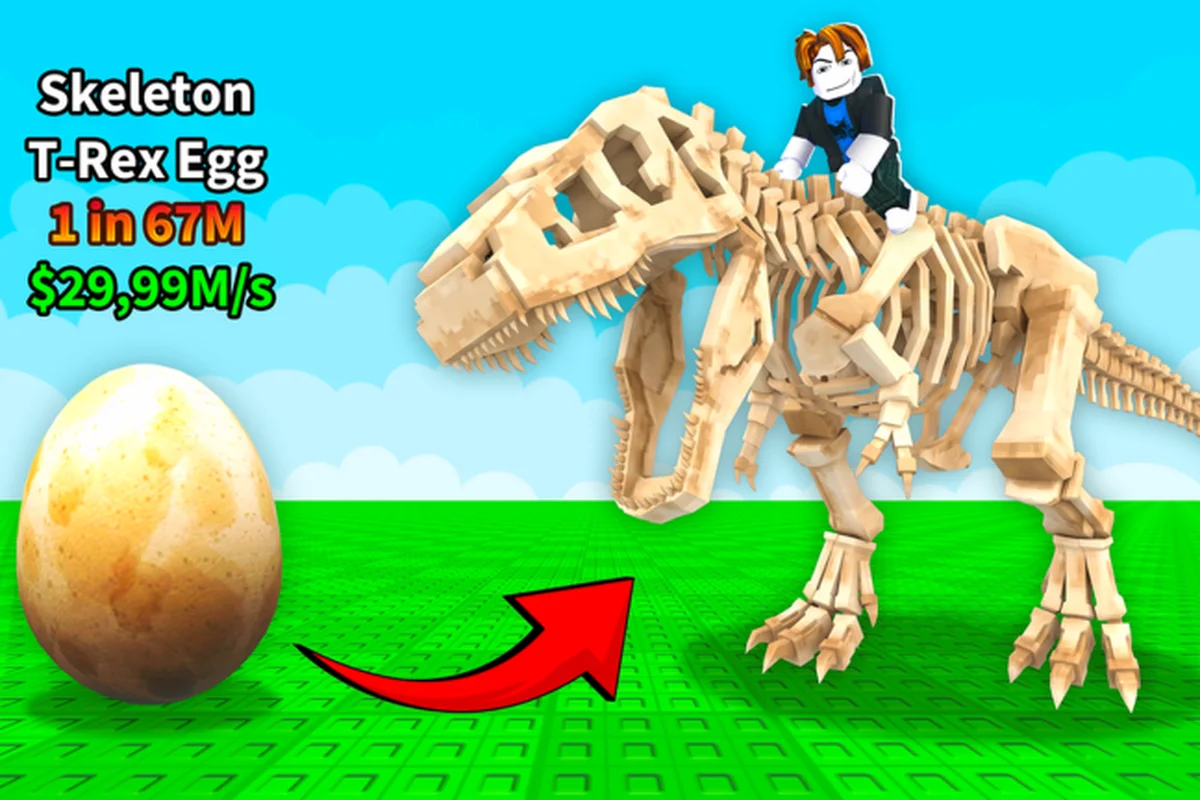
The Ride a Dino radar explained in plain terms is a directional pointer that helps players cut down on the slow part of the loop: wandering the map looking for hidden Dino Eggs. Eggs sit at the core of the experience because every new dinosaur you ride, every rarity upgrade, and every mutation you stack starts with finding one of those spawn points first. A radar does not hatch eggs for you, and it does not boost your dino's speed, but it dramatically reduces the time you spend searching between hatch and ride. That alone can reshape your early-session economy, especially when the map is busy and six-player servers fill up the obvious spawn routes.
Tracing the Pointer's Behavior
The radar in Ride a Dino is a quality-of-life tool that points you toward the nearest unclaimed egg, and it sits at the center of how most players approach the core mechanic loop. The official Roblox page describes the loop as exploring the map to find hidden Dino Eggs, hatching dinos that hatch swifter and rarer, riding swifter mounts to unlock eggs further out, mutating to push speed further, and collecting rare dinos to round out your roster. The radar streamlines the first and most variable step: finding the egg in the first place.
How the Signal Reads on Screen
When you activate the radar, a marker appears somewhere on your screen and updates as you move. If you walk in the wrong direction, the indicator slowly grows. When you angle toward the correct spawn, the indicator tightens, similar to a compass needle homing in on a target. There is no numeric distance readout published by the developer, so the only feedback the radar gives you is directional. Players who have used it consistently report that the signal works best on open ground where you can change direction quickly, and that closed rooms or elevated areas can briefly scramble the lock until you reposition.
Because the game does not publish a species list, a rarity tier list, or any numeric speed values, the radar's purpose stays cleanly mechanical: it removes the searching phase, not the hatching or riding phase. A faster dino still helps you reach the next egg once you know where it is, and mutations still layer on top of that, but the radar only governs "where," not "how fast" or "how rare."
Free Radar vs Infinite Radar
Ride a Dino sells exactly one documented game pass on the official Roblox listing, and it is called Infinite Radar. The pass description on the Roblox marketplace is a single sentence: "A radar you can use forever. Always finds the nearest egg." That wording implies two things. First, the base radar has some kind of usage cap or cooldown, because the pass markets itself as the version that never stops. Second, the underlying "find the nearest egg" mechanic is shared between the free and paid versions, which means Infinite Radar is a convenience upgrade rather than a fundamentally different tool.
There are no other documented game passes, no developer products, and no badges tied to the experience as of 2026-10-18, so when the community talks about "the radar" in Ride a Dino, it almost always refers to this single Infinite Radar pass, with the free version serving as a limited counterpart. The community calls this dynamic the gamepass vs grind trade-off, and it shows up in nearly every early-game decision.
| Radar Type | Access | Usage Limit | Best For |
|---|---|---|---|
| Free Radar | All players | Cooldown between activations | Players still learning the map |
| Infinite Radar (gamepass) | Pass holders | No documented cooldown | Long sessions, completionist hunting |
Range, Cooldown, and What the Game Does Not Publish
The developer has not published numeric values for radar range, cooldown length, refresh rate, or how the lock behaves near server borders. Any specific number you see in a third-party video or a wiki page almost certainly belongs to a similarly named Roblox experience, because Roblox hosts several games that use variations of the "Ride a Dino" name. Community testing suggests the free radar's cooldown is short enough that you can run several searches in a single outing, but long enough that two players on the same cooldown will not be pinged at identical moments. Treat any number you hear as a player-reported estimate rather than a developer-confirmed value.
The Pointer Between Egg and Mount
Radar does not change the loop; it changes how much of your session is spent on which part of the loop. Without a radar, "explore the map" dominates your playtime, and the actual hatching, riding, and mutating steps compress into whatever you can scrape together from the leftover minutes. With a working radar, exploration shrinks to short bursts between hatch and ride, which is where the speed and mutation mechanics start to matter.
Step 1: Locate the Nearest Egg
The radar's first job is to collapse the search radius. You activate the tool, follow the indicator, and watch the marker tighten as you close the gap. Once you are close enough, the egg's interaction prompt appears and you can claim it. Players who have used both versions report that the free radar is enough to clear the beginner spawns comfortably, but as you push toward harder-to-find eggs, the cooldown between activations becomes the bottleneck rather than travel time.
Step 2: Hatch, Then Ride
After you claim the egg, the hatch animation plays and a new dinosaur joins your collection. The official description states that hatching produces "better speed and rarity," which is the only quantitative framing the developer publishes. Once the dino is on the field, you can mount it and use its movement profile to reach the next egg faster, which is the part of the loop where the radar's saved time actually compounds. A hatcher who knows where the next egg is will outpace a hatcher who is still searching, even on identical dinos.
Step 3: Mutate and Push Speed Further
The mutation step exists in the official description as a way to "boost your speed even more." The game does not publish mutation names, drop rates, or stack caps, so treat mutations as a long-term progression layer that you discover through play rather than through a published tier list. The radar's role in this stage is indirect: by removing the search tax, it gives you more hatching attempts per session, which gives you more mutation rolls per session, which gradually moves your roster into the higher-speed brackets.
| Loop Stage | Without Radar | With Radar | Time Saved |
|---|---|---|---|
| Locate egg | High variable cost | Low fixed cost | Most of session |
| Hatch and claim | Same | Same | None |
| Ride to next egg | Same | Same | None |
| Mutate and reroll | Same | Same | None |
The pattern is clear: radar pays off at the front of the loop and stays neutral through the rest. If your bottleneck is exploration, radar is the cheapest lever you can pull. If your bottleneck is hatching luck or mutation variance, radar is irrelevant.
Should You Pay or Keep Grinding
The gamepass vs grind question comes up early because Infinite Radar is the only game pass the developer sells, and it advertises itself as a permanent unlock. That makes the decision more about session style than about raw value, especially in a game where the developer has not published any numeric pricing or cooldown data.
When the Free Radar Is Enough
If you play Ride a Dino in short bursts, log in for a few eggs per session, and mostly stick to beginner-tier spawns, the free radar will carry you through the early game. The cooldown between uses is the main friction, but the cooldown is short enough that you can clear your goals before it becomes annoying. You also get the side benefit of learning where eggs tend to spawn on each map, which is knowledge that a permanent radar can actually obscure. Players who skip the pass often report better map literacy two weeks in than players who skipped straight to Infinite Radar.
When Infinite Radar Pays Off
If you play long sessions, hunt for rarer eggs, or run completionist routes that touch the same map multiple times, Infinite Radar removes the cooldown wall and lets you chain searches back to back. That is also where the "find the nearest egg" wording on the pass starts to matter, because chaining becomes a noticeable quality-of-life lift when you are running an egg-per-minute grind. Players who buy the pass early often describe it as paying for itself in saved frustration rather than saved minutes, which is the right frame for a quality-of-life upgrade.
| Player Profile | Recommended Choice | Why |
|---|---|---|
| Casual, short sessions | Free radar | Cooldown rarely matters |
| Long sessions, rare hunts | Infinite Radar | Chains searches back to back |
| Completionist collector | Infinite Radar | Removes the only bottleneck |
| Map-learner, early player | Free radar | Builds spawn knowledge first |
The Hidden Cost of Skipping the Free Radar Phase
There is a less obvious trade-off in the gamepasses decision: if you buy Infinite Radar on day one, you may never build a personal mental model of where eggs tend to cluster. That model is useful when servers are crowded, when the pass has a temporary issue, or when you join a friend's game and want to contribute quickly. Players who grind with the free radar for a week before buying the pass tend to have a smoother experience across all of those edge cases. If you do buy the pass, treat the first week as a learning window rather than a productivity window.
Comparing Radar to Other Ride a Dino Gamepasses
The community sometimes refers to the wider Ride a Dino gamepasses category as if there were several options, but the official listing only documents one. That makes the comparison simpler than it looks, and it also means you should be skeptical of any third-party list that names a second pass, a developer product, or a premium currency bundle. As of 2026-10-18, Infinite Radar is the only entry in the marketplace for this experience.
What Infinite Radar Is Documented to Do
According to the official Roblox marketplace listing, Infinite Radar is "A radar you can use forever. Always finds the nearest egg." That sentence is the entire documented feature set, and it has not been expanded with patch notes that name additional perks. Players should treat the pass as exactly what the listing says, and not assume any hidden bonuses such as increased range, faster refresh, or a colored indicator. If the developer adds more to the pass in a future update, the marketplace page will be the first place the change appears.
What Infinite Radar Is Not
Infinite Radar is not a hatch booster, not a speed multiplier, not a rarity guarantee, and not a mutation unlock. It does not shorten the hatch animation, it does not give you better odds on the next dinosaur, and it does not let you skip the search entirely. Its value is concentrated in one specific moment: the seconds between wanting an egg and standing in front of one. Any review or tier list that grades the pass on hatch rate or mutation chance is grading it on the wrong axis. The full picture of how speed and mutation work sits in the speed multiplier guide, which covers how the riding and mutation layers stack on top of the radar's contribution.
A Note on Namesake Confusion
Roblox hosts several experiences that use variations of "Ride a Dino" in their title, and at least one of them is a much older, more developed game with multiple passes, multiple species, and a richer economy. The younger experience covered below, with the placeId 131652231424227 and the single Infinite Radar pass, is a sparse-corpus game that launched on 2026-09-18 and most recently updated on 2026-10-12. If you see a tier list, a code list, or a strategy video that names dinosaurs, rarity tiers, mutations, or numeric values, it almost certainly belongs to one of those namesake games rather than to this one. The official page for the experience is the cleanest source of truth and can be checked at the Ride a Dino Roblox page.
Practical Tips for Getting the Most Out of the Radar
A radar is only as useful as the habits you build around it, and Ride a Dino rewards players who treat the tool as a search aid rather than a magic wand. The tips below are grounded in what the developer has actually published and in the loop described on the official page, not in third-party tier lists.
Build a Personal Spawn Map Before You Buy the Pass
If you are still on the free radar, spend your first sessions logging where eggs tend to appear. Use the radar to confirm spawns, then walk the route without it on a later run to see if you can find the same egg from memory. After a few outings, you will have a mental model of the easier spawns, and you will know exactly when the radar is worth activating and when you can skip the cooldown entirely. This habit also gives you a reference point for judging future updates, because you will notice if a spawn pattern changes.
Chain Searches During Long Sessions
If you own the Infinite Radar pass, the main payoff is the ability to chain searches back to back. Instead of activating the radar, walking, and then idling during a cooldown, you can run a tight loop: activate, walk to the egg, claim, hatch, mount, ride toward the next radar ping, and repeat. The chain works best on open ground, where you can swing the camera and change direction quickly. In tight indoor areas, the lock can stutter and force you to back up, so plan your chain around outdoor routes.
Pair Radar Awareness With Egg Collection Goals
Players who treat radar use as a way to fill a collection tend to enjoy the pass more than players who treat it as a way to grind one specific egg. The official description frames the loop as a collection-driven progression, so set realistic per-session goals, such as a number of new dinosaurs rather than a number of hours. The radar then becomes a tool that helps you hit your goal, and you avoid the burnout that comes from chasing a single rare spawn without a clear endpoint. For players who want a deeper breakdown of the collection side of the loop, the egg finder overview maps the same mechanic from the egg-collection angle.
Watch the Server, Not Just the Screen
Because Ride a Dino caps servers at six players, the radar is also a soft social tool. If you see another player pinging the same direction you are, the egg is likely unclaimed and close, and you can race them to the spawn. If you see a player mounted on a clearly faster dino heading the same way, the radar is telling you that the egg is contested, and you may want to pivot to a different ping. Radar is not just a directional arrow; it is also a read on what other players in the server are doing.
| Tip | Free Radar | Infinite Radar |
|---|---|---|
| Build a personal spawn map | High value | Optional |
| Chain back-to-back searches | Limited by cooldown | High value |
| Set collection goals per session | Recommended | Recommended |
| Watch server traffic | Useful | Useful |
| Use mid-run to reroute | Useful | Useful |
When the Radar Is Not the Right Upgrade
Sometimes the answer to "should I buy the radar" is "not yet," and that is a valid outcome of the decision framework. The radar only pays off if the search phase is genuinely your bottleneck, and in some playstyles it is not.
If You Already Know the Spawns
Veteran players who have memorized the easy and medium spawns will burn through their goals in a few minutes per session regardless of whether they own the pass. In that case, the radar is a small convenience rather than a meaningful time save. Save your Robux for a future update that might add a second pass, and revisit the decision when the developer publishes more content.
If Your Bottleneck Is Mutation Variance
Players who have a stable rotation of eggs and a working hatch loop often find that their real ceiling is mutation variance, not search time. No radar configuration will move that ceiling, because mutations are tied to the hatcher step rather than the locator step. In that situation, the better use of session time is to play more sessions and let the law of large numbers do its work, rather than to optimize the search phase. The gamepass value breakdown covers how to weigh this kind of trade-off when the developer eventually adds more passes.
If You Are Still Learning the Map
If you have played fewer than a handful of sessions, the radar is a crutch that can prevent you from learning where eggs tend to appear. New players who buy the pass on day one often find themselves lost when the cooldown kicks in, when the pass is temporarily unavailable, or when they join a server where the radar behaves differently. Spend a week on the free radar, build a spawn map in your head, and then decide whether the pass still feels like a meaningful upgrade.
Frequently Asked Questions
What does the radar do in Ride a Dino?
The radar points you toward the nearest unclaimed egg on the map. It is a directional locator, not a hatch booster or a speed multiplier, and it operates entirely inside the "find an egg" stage of the official core loop. As of 2026-10-18 the developer has not published a numeric range, a cooldown, or a refresh rate, so the only reliable feedback is the on-screen indicator.
Is Infinite Radar the only gamepass in Ride a Dino?
Yes. The official Roblox marketplace listing for the experience documents exactly one game pass, called Infinite Radar, with the description "A radar you can use forever. Always finds the nearest egg." There are no other game passes, no developer products, and no badges attached to the experience as of the most recent official update.
Should I buy the Infinite Radar gamepass or grind with the free radar?
If you play in long sessions and hunt multiple eggs per outing, the Infinite Radar pass removes the cooldown wall and lets you chain searches back to back, which is the main quality-of-life win. If you play short sessions or you are still learning where eggs spawn, the free radar is enough and also gives you better map literacy. The decision is about session style, not about raw value, because the developer has not published a price or a numeric cooldown for either version.
Does the radar make rare dinosaurs easier to find?
The radar finds the nearest egg regardless of rarity, so it speeds up the search but does not change what is inside the egg. Rarity is determined by the hatch step, not the locate step, and the developer has not published a rarity tier list or a hatch rate. Treat the radar as a search tool, not a luck tool, and plan your collection around hatching volume rather than per-egg odds.
Will the radar become obsolete in a future update?
It is possible, because Ride a Dino was last updated on 2026-10-12 and the developer is still actively patching the experience. Any future update could change the free radar's cooldown, add a new feature to the Infinite Radar pass, or even introduce a second game pass. Treat the pass as a current-state purchase and check the official Ride a Dino page before buying if the marketplace has changed since this article was last verified.